Lesson One
It’s 6:58pm and I’m sitting in my level 2 apartment waiting for the air-conditioning to kick in. It gets hot here in the summer, as the west facing windows pour in late afternoon sunlight. On the table in front of me is my laptop and a Pioneer DDJ-400 controller, recently acquired and only tested that day. All plugged in and ready to go, my first DJ lesson will begin shortly.
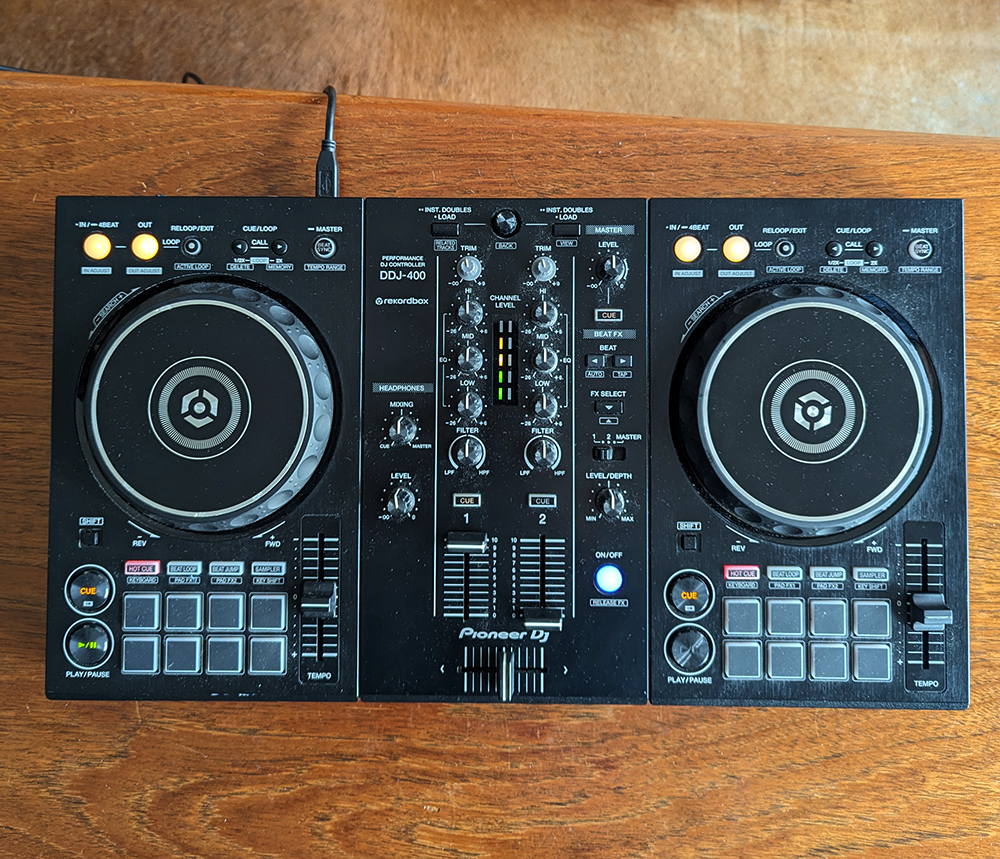
The Pioneer DDJ-400, ready for action.
As I wipe a thin film of perspiration from my brow, my phone buzzes. Colin is here. And no Colin is not the instructor, but my first student.
I walk out to meet a tall, slim built 40-something year old with glasses. In the brief chat we had over the phone, it was clear Colin worked in corporate. Whether it was Law, or Finance I wasn’t sure, but his voice had the cadence and language of a seasoned conference caller. It just so happened he was on a group call when I met him.
“Hey Stav, sorry I’m just finishing this meeting. Actually you know what -”
I saw as he ended a call about ’next quarters projections’ with at least 8 others. He folded the cover of his phone over the screen and slipped it into his back pocket.
“Damn that feels good! Good to meet you Stav - looking forward to you filling me with DJ knowledge.”
We chat briefly in the lift before entering my temporary ‘studio’. After offering Colin a drink, I ask what brought about his interest in DJing, and whether he had any experience.
“Well I run a listed ASX-200 company, so as you can imagine I haven’t had much time for this kind of thing lately. However it’s a new year, and one of my resolutions was to learn how to DJ. Back when I was in Afghanistan we used to throw these parties, and 1 was the one in charge of the music. I guess it started when I was younger throwing raves, but then that re-sparked the interest. Since then I’ve been wanting to do it, it’s only taken me 20 years to get around to it!”
So many questions. I ask the first and most obvious Afghanistan?
“Yeah so I worked in counter-narcotics, based in Kabul. Our job was to identify and locate the big dogs that were pushing the drug trade and bring them down. Those were good days. But it’s been a long time since then, more screens and desk chairs now if you know what I mean. So naturally, I spend a lot of time on Facebook marketplace - I love it! That’s how I found your ad. I could tell, this guy knows what he’s doing.”
I knew there was hours and hours of stories in that one avenue alone. It was already 7:05pm so I decided to resist the urge for more questions, we only had an hour together after all.
I asked Colin what his goals with this were, as I figured this was the easiest way to gauge the scope of training he was interested in acquiring.
“My goal would be to learn enough to DJ my birthday party next year. How long do you think that would take? Is that doable? If I spent say a year practicing would I be proficient?”
“Absolutely. The great thing about using Rekordbox and the controller/laptop setup, is the ability to adjust the difficulty levels you desire. Rekordbox is powerful software that help you organise and analyse your music, reading each tracks BPM (tempo) and Key, as well as mapping a beat grid onto the waveform. With Auto Beat-matching settings you can essentially automate one of the hardest parts of Djing - beat matching. This helps make things a bit easier when starting out.”
Colin’s eyes had narrowed, as he processed this information. As someone who has Dj-ed on and off for the last 10 years, all of this information is banked in my head as images, concepts and fragments of sentences. One of the first things I noticed about teaching something you have done for so long is the need to articulate these ideas into language that is succinct and accessible (especially for a beginner), and then present it in a way that the instructions can be useful.
After a beat, Colin began rapid-firing questions at me. My mind worked harder to crunch the data needed to explain concepts about each of the components of the controller - what they did and how they helped you to control the sound. I could tell by each of Colin’s enquiries that he was a natural born learner. I could see the moment each of the previous pieces of information fit into the map that was growing inside his head, and Colin began asking questions about components and processes ocesses that I hadn’t yet reached.
“Okay so the tempo sliders, they control the speed at which the song progresses - but is the change on the slide always at the same rate? So if you’ve got a song that’s 80BPM and another that’s 120BPM, the same movement on the slider will produce a larger change… for the 80BPM track?”
Tempo rate change is an insightful observation.
“Actually no the 120BPM track will have a bigger change, as the slider is default set to +/-6% of BPM change of each track. However you can increase the rate at which the BPM changes here -”
I point to the part of the interface that controls rate of change.
“So you can set it at +/-10%, +/-16% or WIDE, which doubles the BPM. You rarely want to use this last setting though, as the tempo slider will become far too sensitive and you wouldn’t be able to match the BPMs easily.”
“Right, and obviously you ideally want the BPM of each track to be close to the other that you are mixing into, so that you don’t need to change the BPM of one or the other too much.”
“Exactly.”
Colin smiled as he felt himself gaining traction. This spurred a brief recounting of his days as young rave hustler.
“Great Stav, I’ll pick up one of these controllers and be in touch. I’ll try and practice a bit at home, and then we can do a few more lessons. Any questions I’ll be sure to reach out, I’ve got your details. You’re a good teacher!”
And with that Colin was out the door and down into the cool evening light.
I sat on the couch and went over the last hour in my head - it flew by! Curious as to exactly who Colin is, I did a quick Google. It didn’t take long to find Colin’s company website, along with a photo of him and his bio - former army officer, admitted lawyer and graduate of Oxford university. Impressive to say the least.
It felt slightly surreal that I had been teaching someone so accomplished, and interesting to know that I was adding more information into an already very full brain. I also admired Colin in that moment, as it was clear this was a person who wasn’t afraid to become the novice again, and not only prioritised this foundational learning, but was excited for it.
- Stav Rose